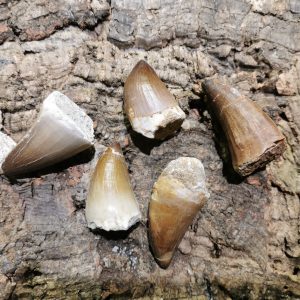
Just like many reptile keepers; here at Ridgeway we are fans of all aspects of the natural world, modern and ancient; particularly Dinosaurs!
Fossil teeth are among the most common fossils found due to their hard structure and the frequency they are lost during growth, feeding and fighting. Fossil teeth have been discovered in various locations worldwide, representing numerous dinosaur species across the Mesozoic era, including the Triassic, Jurassic, and Cretaceous periods. Teeth are durable and often preserved even when other parts of the skeleton have eroded or decayed, making them critical tools for understanding dinosaur diversity and evolution.
Teeth are particularly important to scientists studying dinosaurs as they allow a great understanding of their feeding behaviour, diets, and other evolutionary adaptations. The serrated teeth of carnivorous theropods show clearly their ability to tear flesh and the flat, grinding teeth of herbivorous dinosaurs help us learn more about their plant diets. Teeth reveal a lot about the lives of dinosaurs and their role in ancient habitats.
Fossilised shark teeth are also a relatively common occurrence, and due to the soft cartilaginous bones of sharks; they are often the only remains found. Sharks are arguably the Earth’s most successful groups of predators, having been around for over 400 million years. They have lived through various geological periods, survived mass extinctions that wiped out most other large predators and continuously adapted and thrived in different marine environments.